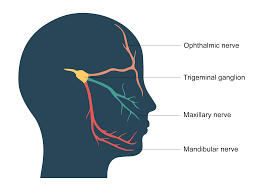
Trigeminal Neuralgia (TN)
Trigeminal Neuralgia (TN)
What is Trigeminal Neuralgia?
Trigeminal Neuralgia is a chronic pain condition that affects the trigeminal nerve, which is one of the largest nerves in the head. It causes sudden, severe, and sharp facial pain, usually on one side of the face. The pain episodes can be triggered by simple activities like talking, chewing, or even touching the face.
Anatomy Background
-
Trigeminal nerve (cranial nerve V): It has three major branches:
-
Ophthalmic (V1)
-
Maxillary (V2)
-
Mandibular (V3)
-
-
TN usually affects one or more of these branches, causing pain in the corresponding area of the face.
Causes
-
Vascular compression: The most common cause is a blood vessel compressing the trigeminal nerve near its root.
-
Multiple sclerosis (MS): Demyelination can lead to nerve irritation.
-
Tumors: Rarely, tumors can compress the nerve.
-
Injury: Facial trauma or surgery can trigger TN.
-
Idiopathic: Sometimes the cause is unknown.
Symptoms
-
Sudden, severe, electric shock-like or stabbing pain on one side of the face.
-
Pain episodes lasting seconds to a few minutes but can repeat multiple times per day.
-
Triggers include light touch, chewing, speaking, brushing teeth, or even a breeze.
-
Pain can be localized to areas supplied by the trigeminal nerve branches (cheek, jaw, forehead, teeth).
Types of Trigeminal Neuralgia
-
Classical TN: Caused by vascular compression.
-
Secondary TN: Due to underlying conditions like MS or tumors.
-
Idiopathic TN: No identifiable cause.
Diagnosis
-
Clinical history and physical examination.
-
MRI to rule out vascular compression, tumors, or MS.
-
Neurological examination to assess nerve function.
Treatment
Medical Treatment
-
First-line: Anticonvulsants such as carbamazepine or oxcarbazepine.
-
Other medications: Gabapentin, baclofen, lamotrigine.
-
Pain relief with careful dose adjustment due to side effects.
Surgical Treatment
-
Microvascular decompression: Relieves pressure on the nerve.
-
Gamma Knife radiosurgery: Non-invasive radiation therapy.
-
Rhizotomy: Procedures that destroy nerve fibers to block pain.
Alternative/Supportive Care
-
Avoiding triggers.
-
Managing stress.
-
Complementary therapies like acupuncture (limited evidence).
Prognosis
-
Variable; many patients respond well to medication.
-
Pain can recur, and some require surgery.
-
Early treatment improves quality of life.
When to see a doctor?
-
Sudden onset of severe facial pain.
-
Pain worsens or affects daily life.
-
Symptoms associated with weakness, numbness, or vision problems.