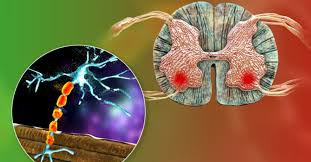
Primary Lateral Sclerosis
Primary Lateral Sclerosis (PLS)
Definition:
Primary Lateral Sclerosis (PLS) is a rare, progressive neurological disorder characterized by the degeneration of the upper motor neurons in the brain and spinal cord. Unlike Amyotrophic Lateral Sclerosis (ALS), PLS primarily affects upper motor neurons and usually has a slower progression without significant lower motor neuron involvement.
Causes:
-
The exact cause of PLS is unknown.
-
It is believed to involve degeneration of the corticospinal tracts.
-
Genetic factors might play a role in some cases, but no specific gene mutation has been definitively linked.
-
It is considered a sporadic neurodegenerative disorder.
Pathophysiology:
-
Degeneration of upper motor neurons leads to impaired motor control.
-
Damage primarily affects voluntary muscle movements, causing stiffness and weakness.
-
Lower motor neurons remain largely unaffected, differentiating it from ALS.
Symptoms:
-
Progressive muscle stiffness (spasticity)
-
Muscle weakness, primarily in legs first, then spreading to arms and face
-
Difficulty with balance and coordination (ataxia)
-
Slowed or slurred speech (dysarthria)
-
Difficulty swallowing (dysphagia) in later stages
-
Muscle cramps and spasms
-
No significant muscle wasting or fasciculations (twitching), unlike ALS
Types:
-
Classic PLS: Slowly progressive spasticity and weakness, usually starting in the legs.
-
Bulbar PLS: Primarily affects muscles of speech and swallowing.
-
Pseudobulbar Palsy: Upper motor neuron signs affecting face and throat muscles.
Diagnosis:
-
Clinical examination showing upper motor neuron signs without lower motor neuron signs.
-
MRI to rule out other causes such as multiple sclerosis or spinal cord lesions.
-
Electromyography (EMG) to confirm absence of lower motor neuron involvement.
-
Blood tests to exclude other disorders.
-
Diagnosis is mainly clinical and by exclusion, often requiring observation over time.
Treatment:
-
No cure currently available.
-
Treatment is symptomatic and supportive:
-
Muscle relaxants (e.g., baclofen, tizanidine) to reduce spasticity.
-
Physical therapy to maintain mobility and reduce stiffness.
-
Speech therapy if speech/swallowing is affected.
-
Assistive devices such as canes, walkers, or wheelchairs for mobility.
-
-
Regular monitoring by neurologists.
Prognosis:
-
PLS progresses more slowly than ALS.
-
Life expectancy is usually longer; some patients live many years with manageable symptoms.
-
Does not typically cause significant muscle wasting or respiratory failure as seen in ALS.
-
Some patients may eventually develop lower motor neuron signs, progressing toward ALS, but this is rare.
If you want, I can also provide info on homeopathic or Ayurvedic management options, or suggest ways to cope with symptoms day-to-day. Would you like that?