Parkinsonism
Parkinsonism Overview
Definition:
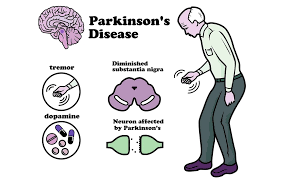
Parkinsonism refers to a group of neurological disorders that cause movement problems similar to those seen in Parkinson’s disease (PD). It is characterized primarily by symptoms such as tremors, rigidity, bradykinesia (slowness of movement), and postural instability.
Causes:
Parkinsonism can be caused by:
-
Idiopathic Parkinson’s Disease (most common form)
-
Secondary Parkinsonism due to:
-
Medications (e.g., antipsychotics, antiemetics)
-
Toxins (e.g., manganese, carbon monoxide poisoning)
-
Brain injury or trauma
-
Stroke affecting the basal ganglia
-
Infections
-
-
Atypical Parkinsonism or Parkinson-plus syndromes, such as:
-
Progressive Supranuclear Palsy (PSP)
-
Multiple System Atrophy (MSA)
-
Corticobasal Degeneration (CBD)
-
-
Genetic causes (rare familial forms)
Symptoms:
-
Tremor (resting tremor, often “pill-rolling” type)
-
Muscle rigidity (stiffness)
-
Bradykinesia (slowness in initiating and performing movements)
-
Postural instability (balance problems, falls)
-
Gait changes (shuffling walk)
-
Masked face (reduced facial expression)
-
Speech changes (soft or slurred speech)
-
Other non-motor symptoms (depression, constipation, sleep disturbances, cognitive impairment)
Diagnosis:
-
Primarily clinical, based on history and physical examination.
-
Imaging (MRI, DaTscan) may be used to exclude other causes.
-
Response to levodopa (a dopamine precursor) can help differentiate Parkinson’s disease from other forms.
Treatment:
1. Medications:
-
Levodopa + Carbidopa: Mainstay of treatment to replenish dopamine.
-
Dopamine agonists: (e.g., pramipexole, ropinirole)
-
MAO-B inhibitors: (e.g., selegiline, rasagiline)
-
COMT inhibitors: (e.g., entacapone)
-
Anticholinergics: (for tremor control in some cases)
2. Non-Pharmacological:
-
Physical therapy: Improves mobility, balance, and strength.
-
Occupational therapy: Aids in daily activities.
-
Speech therapy: Helps with speech and swallowing issues.
3. Surgical:
-
Deep Brain Stimulation (DBS): For advanced cases with medication side effects.
Prognosis:
-
Parkinsonism is generally progressive.
-
Idiopathic Parkinson’s disease progresses slowly.
-
Atypical Parkinsonism usually progresses faster and has a poorer prognosis.
Summary:
Parkinsonism is a syndrome with movement abnormalities mainly due to loss or dysfunction of dopamine-producing neurons. It includes Parkinson’s disease and several other conditions with similar symptoms but different causes and treatments.