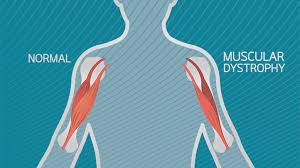
Muscular Dystrophy
Muscular Dystrophy (MD)
What is Muscular Dystrophy?
Muscular Dystrophy refers to a group of genetic disorders characterized by progressive weakness and degeneration of the skeletal muscles that control movement. It results from mutations in genes responsible for muscle integrity and function.
Types of Muscular Dystrophy
There are several types of MD, each differing by age of onset, muscle groups affected, and genetic cause:
-
Duchenne Muscular Dystrophy (DMD)
-
Most common in children, mostly boys.
-
Symptoms begin around ages 2-3.
-
Rapid progression, usually wheelchair-bound by adolescence.
-
-
Becker Muscular Dystrophy (BMD)
-
Similar to DMD but slower progression.
-
Symptoms appear in teens or adulthood.
-
-
Myotonic Dystrophy
-
Adult onset.
-
Characterized by muscle stiffness (myotonia) and weakness.
-
Can affect multiple body systems.
-
-
Facioscapulohumeral Muscular Dystrophy (FSHD)
-
Affects muscles of face, shoulder blades, and upper arms.
-
Variable age of onset and progression.
-
-
Limb-Girdle Muscular Dystrophy (LGMD)
-
Affects muscles around hips and shoulders.
-
Onset varies widely, from childhood to adulthood.
-
-
Congenital Muscular Dystrophy
-
Present at birth or early infancy.
-
Causes muscle weakness and sometimes brain abnormalities.
-
-
Emery-Dreifuss Muscular Dystrophy
-
Affects shoulder, upper arm, and calf muscles.
-
Can involve heart problems.
-
Causes
-
Genetic mutations affecting proteins needed for healthy muscle function, such as dystrophin in DMD and BMD.
-
Inherited in different patterns (X-linked, autosomal dominant, autosomal recessive).
Symptoms
-
Muscle weakness and wasting.
-
Difficulty walking or running.
-
Frequent falls.
-
Muscle cramps and stiffness.
-
Enlarged calf muscles (pseudohypertrophy) especially in Duchenne.
-
Heart and respiratory complications in some types.
-
Difficulty with motor skills and delayed milestones in children.
Diagnosis
-
Clinical examination and family history.
-
Blood tests: Elevated creatine kinase (CK) levels.
-
Genetic testing to identify mutations.
-
Muscle biopsy (less common now due to genetic testing).
-
Electromyography (EMG) to evaluate muscle electrical activity.
Treatment
Currently, there is no cure for muscular dystrophy, but treatments focus on managing symptoms and improving quality of life:
-
Physical therapy to maintain muscle strength and flexibility.
-
Occupational therapy to assist daily activities.
-
Medications:
-
Corticosteroids (like prednisone) to slow muscle degeneration.
-
Heart medications if cardiac involvement.
-
-
Assistive devices: braces, wheelchairs.
-
Surgery for contractures or scoliosis.
-
Respiratory support in advanced stages.
Prognosis
-
Depends on the type of MD.
-
Duchenne has a more severe progression, often limiting lifespan to young adulthood.
-
Others like Becker or limb-girdle forms can have slower progression and longer life expectancy.