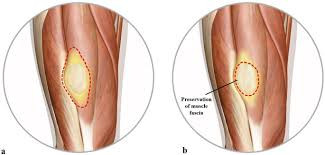
Intramuscular Myxoma
Intramuscular Myxoma – Overview
Definition:
Intramuscular myxoma is a rare, benign (non-cancerous) soft tissue tumor composed of immature fibroblasts and abundant myxoid (gel-like) stroma. It usually arises within the skeletal muscle and grows slowly.
Epidemiology:
-
Incidence: Rare (less than 1 per million)
-
Age group: Most common in adults between 40–70 years
-
Sex: Slight female predominance
Common Locations:
-
Thigh
-
Shoulder
-
Buttocks
-
Arm or calf muscles
Symptoms:
-
Painless, slowly enlarging soft tissue mass
-
Usually non-tender
-
Rarely causes functional impairment
-
May go unnoticed for years
Causes and Risk Factors:
-
Mostly sporadic, with no known cause
-
May be associated with Mazabraud’s syndrome (a rare condition combining intramuscular myxomas and fibrous dysplasia of bone)
Diagnosis:
1. Imaging:
-
MRI: Preferred method
-
Well-defined, homogeneous, hypointense on T1, hyperintense on T2
-
May show mild enhancement with contrast
-
-
Ultrasound: Shows a hypoechoic, well-demarcated mass
2. Biopsy:
-
Histopathology confirms diagnosis:
-
Spindle-shaped cells
-
Scant cytoplasm
-
Abundant myxoid matrix
-
Low cellularity
-
No atypia or mitosis
-
Differential Diagnosis:
-
Myxoid liposarcoma
-
Low-grade fibromyxoid sarcoma
-
Nodular fasciitis
-
Ganglion cyst
-
Neurogenic tumor
Treatment:
-
Surgical excision is the treatment of choice
-
Complete removal with clear margins
-
Recurrence is rare if fully excised
-
Prognosis:
-
Excellent
-
No risk of malignancy
-
Very low recurrence rate after complete resection
Conclusion:
Intramuscular myxoma is a benign tumor of muscle tissue that presents as a painless mass, typically in middle-aged adults. While rare, it is important to distinguish it from malignant tumors using imaging and biopsy, with surgical excision being curative in most cases.