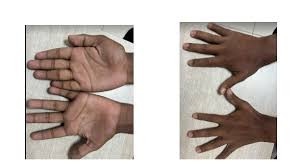
Hirayama Disease (HD)
Hirayama Disease (HD)
Also known as Monomelic Amyotrophy
Definition
Hirayama Disease is a rare, non-progressive motor neuron disorder characterized by asymmetric muscle weakness and wasting, typically affecting the distal upper limbs (hands and forearms), usually in young males.
Key Features
-
Onset: Usually between 15–25 years
-
Gender: Predominantly males
-
Progression: Slowly progressive for 1–5 years, then stabilizes
-
Laterality: Often affects one side more than the other
Symptoms
-
Weakness in one hand and forearm
-
Muscle wasting (especially in the thenar, hypothenar, and forearm muscles)
-
Cold sensitivity: Weakness worsens in cold environments
-
No sensory loss or very minimal sensory symptoms
-
Absence of upper motor neuron signs
Causes and Pathophysiology
-
Thought to be caused by dynamic compression of the lower cervical spinal cord (especially C7-T1) during neck flexion.
-
Due to disproportionate growth between the spinal cord and vertebral column in adolescence.
-
Venous congestion and ischemia contribute to motor neuron damage.
Diagnosis
-
Clinical evaluation based on symptoms and history
-
MRI Cervical Spine (neutral and flexion positions):
-
Shows forward displacement of the posterior dura
-
Compression of the spinal cord in flexion
-
-
EMG/NCV (Electromyography/Nerve conduction):
-
Denervation in C7-T1 innervated muscles
-
-
No sensory involvement, helps differentiate from other neuropathies
Differential Diagnoses
-
Amyotrophic Lateral Sclerosis (ALS)
-
Cervical spondylotic myelopathy
-
Peripheral neuropathy
-
Syringomyelia
-
Spinal muscular atrophy
Treatment
There is no cure, but progression can often be halted or slowed.
Conservative Management
-
Cervical collar/neck brace: Prevents neck flexion and reduces spinal cord compression
-
Physiotherapy: To preserve function and prevent contractures
-
Avoidance of neck flexion
Medications
-
Not very effective; sometimes NSAIDs for discomfort
Surgery (in rare severe cases)
-
Anterior cervical decompression
-
Dural fixation or spinal fusion (in progressive cases)
Prognosis
-
Typically benign after the initial progressive phase
-
Weakness usually stabilizes
-
Rarely becomes bilateral or progresses to involve lower limbs
Alternative Therapies
Homeopathy/Ayurveda:
No proven cures, but some patients may seek:
-
Homeopathic remedies for nerve strength (under supervision)
-
Ayurvedic therapies to reduce vata dosha (e.g., Abhyanga, Basti, herbal decoctions like Ashwagandha, Bala)
Note: These are supportive and should not replace conventional diagnosis or care.
Conclusion
Hirayama Disease is a self-limiting neurological condition affecting young men. Early diagnosis and postural precautions (like avoiding neck flexion) are key to preventing progression. While there is no cure, appropriate conservative management offers a good long-term outcome.